When a visionary company burns through cash to scale revolutionary manufacturing, does raising capital signal prudent risk management—or does it unnecessarily punish shareholders when operational discipline could preserve value?
Tesla stands at a pivotal moment in automotive history. The company has successfully proven that electric vehicles can be desirable, high-performance products that compete with—and surpass—traditional luxury vehicles. But proving concept and achieving mass-market scale are entirely different challenges.
The Model 3, positioned as Tesla's first mass-market vehicle, represents the company's most ambitious manufacturing undertaking to date. To deliver on reservations from hundreds of thousands of customers and justify the company's lofty valuation, Tesla must transition from a boutique manufacturer producing tens of thousands of vehicles annually to a true automotive powerhouse producing hundreds of thousands—eventually millions—of units.
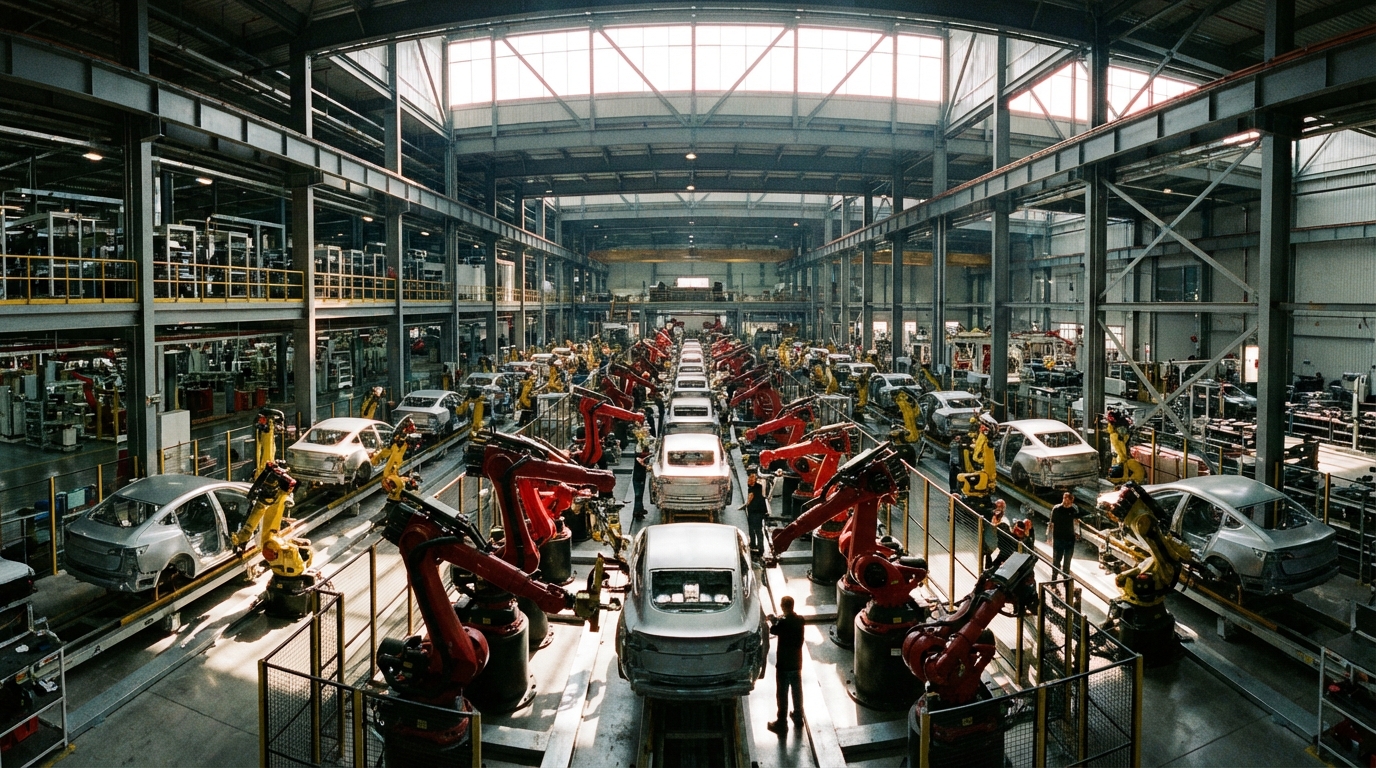
This scale-up requires unprecedented capital investment: new factories, advanced automation systems, expanded supply chains, and the human capital to orchestrate it all. Tesla's Fremont facility undergoes massive retooling. The Gigafactory in Nevada—a bet-the-company investment in battery production—devours capital at a staggering rate. Manufacturing "production hell" becomes a reality as the company struggles to hit production targets quarter after quarter.
Meanwhile, Tesla's cash position tells a sobering story. Operating cash flow turns deeply negative as the company invests billions in capital expenditures while ramping production. The burn rate reaches levels that would bankrupt most companies within quarters. Wall Street analysts openly question whether Tesla has sufficient runway to achieve sustainable production before the money runs out.
Source: Illustrative data based on typical capital-intensive manufacturing scale-up patterns
Short sellers circle, betting billions that Tesla will collapse before reaching profitability. Media coverage amplifies every production miss, every quality concern, every executive departure. The narrative shifts from "Can Tesla succeed?" to "Will Tesla survive?"
Yet despite the skepticism—or perhaps because of the high drama—capital markets remain open to Tesla. The company's equity trades at valuations that seem to price in eventual success rather than imminent failure. Convertible debt investors, attracted by the potential upside in Tesla's stock, provide another avenue for capital. Each quarterly earnings call becomes a referendum on the company's financial health and strategic direction.
Tesla's leadership faces a fundamental choice about how to navigate this period of maximum cash consumption. The company could aggressively tap capital markets while they remain receptive, building a war chest that provides cushion against delays, setbacks, or market disruptions. Alternatively, management could prioritize operational efficiency and capital discipline, avoiding dilution by forcing the organization to achieve profitability with existing resources.
As Tesla evaluates its options, several financial considerations dominate the analysis: Share dilution from equity offerings reduces existing shareholders' ownership percentages. Convertible debt provides capital today but creates potential future dilution if the stock performs well. Public market signaling from each capital raise sends messages about management's confidence and financial health. Cost of capital varies significantly based on market sentiment and company performance.
The decision carries enormous consequences. Raise too much capital, and shareholders suffer unnecessary dilution during a period when the stock could appreciate dramatically if production succeeds. Raise too little, and the company risks running out of cash before reaching the promised land of positive operating cash flow—potentially forcing a distressed capital raise at punitive terms, or worse, bankruptcy.
This dilemma extends beyond Tesla's specific circumstances to fundamental questions in corporate finance. When scaling businesses with high capital intensity and uncertain timelines, how should management balance shareholder dilution concerns against existential liquidity risks? Does the market reward conservative capital management that preserves ownership structure, or does it punish companies that run too close to the financial edge?
Historical examples provide conflicting lessons. Amazon famously raised capital aggressively during its growth phase, diluting early shareholders but ensuring the company had resources to dominate e-commerce. Conversely, numerous high-flying startups have failed not from flawed business models but from running out of cash during execution challenges. The graveyard of "promising companies that needed just six more months" serves as a cautionary tale.
Source: Illustrative scenario analysis of capital structure decisions
For Tesla, the stakes are amplified by the company's mission-driven narrative and polarized investor base. True believers see any dilution as temporary pain toward revolutionary impact on sustainable transportation. Skeptics view each capital raise as evidence that the business model doesn't work and management is simply postponing the inevitable reckoning.

You are Tesla's CFO during the critical Model 3 ramp period. Cash burn is severe, production targets are being missed, and skeptics predict bankruptcy. However, capital markets remain open—investors still believe in the long-term vision, even as they question near-term execution.
Your cash balance provides approximately 6-9 months of runway at current burn rates. You could extend that runway through aggressive capital raises—equity offerings, convertible debt, or both. However, each raise dilutes existing shareholders and potentially signals weakness to the market.
What capital strategy do you pursue?
Before you discover how Tesla actually handled this situation, consider the strategic alternatives available and their implications for shareholders, operations, and long-term company viability.
Supporters of aggressive capital raising argue that Tesla's mission and market opportunity justify temporary dilution. If the company succeeds in transforming the auto industry, early shareholders will be rewarded many times over despite ownership percentage declining.
From this view, the worst outcome isn't dilution—it's bankruptcy. Running out of cash would destroy 100% of shareholder value, while dilution might reduce ownership by 20-30% but preserve equity in a potentially trillion-dollar company.
Amazon's history provides the playbook: Jeff Bezos raised capital aggressively during the dot-com era, diluting early investors but ensuring the company survived to dominate multiple industries. Patient shareholders were ultimately rewarded spectacularly.
Critics contend that aggressive capital raising masks operational failures and removes accountability. If management knows capital markets will continually bail them out, where's the incentive to achieve true efficiency?
From this perspective, repeated capital raises signal that the business model doesn't work at current cost structures. Real companies achieve profitability through discipline and execution, not through serial dilution of their shareholders.
The counter-example: companies that raised "just one more round" repeatedly before ultimately failing anyway, leaving shareholders with worthless stakes that had been diluted five or six times along the way.
Source: Scenario modeling of shareholder outcomes under different capital strategies
This case sits at the intersection of several key corporate finance concepts: pecking order theory (companies prefer internal financing, then debt, then equity), the trade-off theory of capital structure (balancing tax benefits and bankruptcy costs), and signaling theory (what capital raises communicate to markets about management's private information). The optimal decision depends on which theoretical framework you believe best describes real-world capital markets.
Tesla chose Option 1: aggressive, repeated capital raising throughout the Model 3 production ramp. Between 2016 and 2019, the company raised billions through multiple mechanisms:
Each capital raise generated headlines questioning Tesla's viability. Shorts celebrated each announcement as evidence of impending bankruptcy. Existing shareholders watched their ownership percentages decline quarter after quarter.
Tesla's leadership, particularly CEO Elon Musk and successive CFOs, consistently articulated that eliminating bankruptcy risk was paramount. The company's mission—accelerating sustainable transportation—was too important to gamble on achieving profitability within a precise timeframe.
Management argued that manufacturing scale-up in automotive involves unpredictable challenges. Supply chain disruptions, automation setbacks, quality issues, and workforce training all introduce variables that make precise cash flow forecasting nearly impossible. Building a capital cushion wasn't evidence of failed strategy; it was prudent risk management given the stakes.
Critically, Tesla raised capital during periods when markets remained receptive despite skepticism. The company's stock, while volatile, maintained valuations that made equity financing relatively less dilutive than it might have been during distressed conditions. Convertible debt terms, while not cheap, were available at rates that reflected belief in eventual success rather than imminent failure.
This timing proved essential: by the time production stabilized and cash flow turned positive in late 2019-2020, capital markets had tightened significantly. Had Tesla waited, the capital might not have been available at acceptable terms.
Despite having capital cushion, Tesla still endured "production hell." Musk famously slept on the factory floor. The company implemented intense cost-cutting measures. Automation systems that didn't work were torn out and replaced with human workers. The organization operated with urgency despite having capital reserves.
This suggests that having capital didn't eliminate operational discipline—it provided runway to solve problems without facing existential crisis every quarter. Engineers could focus on fixing production bottlenecks rather than fire-fighting to extend cash runway.
Source: Illustrative representation of capital raising timeline and outcomes
By late 2019, Tesla achieved sustained positive operating cash flow. Model 3 production stabilized at rates that made the vehicle profitable. The company's stock price began a historic run that would eventually make it the world's most valuable automaker by market capitalization—despite producing a fraction of the unit volume of traditional competitors.
Shareholders who held through the dilution experienced extraordinary returns. A $10,000 investment in early 2016 would have been worth over $200,000 by late 2021 (pre-split basis), despite ownership percentage declining through capital raises. The dilution, while real, proved immaterial compared to the enterprise value creation.
The unanswerable question: would Tesla have achieved the same outcome with greater capital discipline? Critics argue that forcing profitability earlier would have created a leaner, more efficient organization and delivered better shareholder returns. Supporters contend that attempting to operate without capital cushion would have resulted in bankruptcy during one of the many crises that plagued the production ramp.
Both positions remain unfalsifiable. We can observe only the path Tesla took, not the alternative timelines where different choices were made.
Tesla's case illuminates several principles for capital structure decisions during high-growth, capital-intensive periods:
Having capital provides options that aren't available in crisis mode. Tesla could invest in quality improvements, R&D, and brand building that would have been impossible if every dollar went to survival. This optionality likely accelerated the company's competitive position development.
Tesla raised capital when markets were receptive, not when the company desperately needed it. This distinction matters enormously for terms, dilution, and signaling effects. Companies that wait until crisis often face far worse terms or find markets closed entirely.
For companies pursuing transformational missions (whether electric vehicles, space exploration, or other moonshots), existential risk management may rationally take priority over optimal financial engineering. The expected value calculation differs when downside is total failure rather than mediocre returns.
Dilution matters far less than enterprise value creation. Shareholders prefer owning 10% of a $100 billion company over 15% of a $20 billion company. Tesla's aggressive capital strategy proved acceptable because the company continued growing total value faster than it diluted ownership.
Evaluating decisions based on outcomes rather than information available at decision time creates false lessons. Tesla's strategy looks brilliant now but appeared reckless to many observers in 2017-2018. The quality of the decision should be assessed based on the risk-reward profile at the time, not the eventual outcome.
Tesla's case has influenced how capital markets evaluate other capital-intensive, mission-driven companies. Investors increasingly accept that companies pursuing transformational goals may require patient capital and tolerance for dilution during scale-up phases.
However, the strategy's success has also created risks of overconfidence. Not every company that raises capital aggressively will succeed in creating sufficient value to justify the dilution. Tesla's outcome doesn't validate the approach universally—it demonstrates that in specific circumstances, with specific execution, aggressive capital raising can enable success rather than merely postponing failure.
The case remains a touchstone for CFOs, boards, and investors navigating similar decisions: when facing the tension between shareholder dilution and existential risk, how much insurance is prudent, and at what cost?
To properly evaluate Tesla's capital strategy, consider these key analytical dimensions that should inform any similar decision:
| Analysis Dimension | Key Questions | Tesla-Specific Considerations |
|---|---|---|
| Liquidity Risk Assessment | What's the probability distribution of cash runway outcomes? What's the bankruptcy risk at different capital levels? | Manufacturing ramp timelines highly uncertain; automotive industry capital intensity creates binary outcomes (success vs. failure) |
| Dilution Cost Analysis | What's the net present value impact of dilution vs. bankruptcy risk? How do different shareholders value ownership percentage vs. total value? | Long-term believers willing to accept dilution; short-term traders and shorts amplify every capital raise negatively |
| Market Timing Assessment | How receptive are capital markets now vs. likely future states? What's the option value of accessing capital before you need it? | Capital available despite skepticism in 2016-2018; may not be available during crisis; timing proved crucial |
| Operational Flexibility | How does capital cushion affect strategic decision-making? Does abundant capital reduce discipline or enable better outcomes? | Allowed quality investments and R&D continuation; didn't eliminate operational urgency in practice |
| Signaling Effects | What messages do capital raises send to stakeholders? How do you manage narrative to minimize negative interpretations? | Each raise questioned viability; management framed as offense not defense; results ultimately validated strategy |
| Instrument Selection | Equity vs. debt vs. convertibles—which structure optimizes cost of capital and dilution timing? | Used mix of instruments; convertibles deferred dilution; secured debt restricted some flexibility |
One approach to this decision involves expected value calculation across scenarios:
Source: Simplified expected value framework for capital strategy decision analysis
Assume three scenarios: (1) Production ramp succeeds quickly, (2) Production ramp succeeds slowly with setbacks, (3) Production ramp fails. Assign probabilities and value outcomes under each capital strategy. The strategy that maximizes expected shareholder value depends critically on your probability assessments and value estimates—which explains why reasonable people disagree so intensely on the correct approach.
Financial models can inform but not fully resolve this decision. Several qualitative factors matter enormously:
While Tesla's case is unique, the framework applies broadly to capital-intensive scale-ups: biotech companies burning cash through clinical trials, infrastructure projects with long payback periods, subscription businesses investing for growth, and manufacturing operations requiring significant upfront investment.
The key insight: there's no universally correct answer to the growth vs. dilution question. The optimal strategy depends on specific circumstances, risk assessments, stakeholder preferences, and market conditions. What makes this an excellent case study is that Tesla's eventual success doesn't prove the decision was obviously correct—it demonstrates that under specific conditions, aggressive capital raising can enable outcomes that justify the dilution.
The case challenges us to think probabilistically about financial strategy rather than searching for universal rules. Different companies, different stages, different markets, and different risk profiles require different approaches to balancing growth financing against shareholder dilution concerns.